
The History of the Christmas Carol: How Holiday Music Came to Life
GET STARTED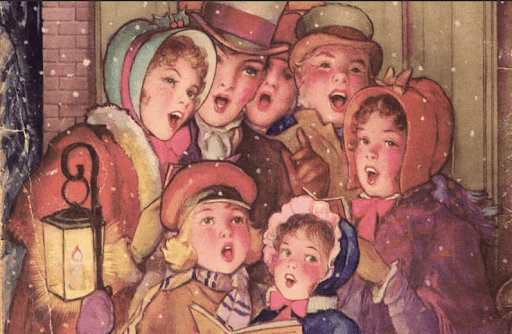
Every December, we hear cheerful voices singing about reindeer, snowmen, and coming together as a community. Christmas carols fill homes, schools, and even shopping centers with joy. But have you ever wondered where these songs came from?
The story of the Christmas carol is a fascinating journey through time, a journey that begins long before Christmas as we know it even existed!

Long Before Christmas: Singing in the Winter
Over a thousand years before anyone sang “Jingle Bells” or “Silent Night”, people in Europe celebrated the Winter Solstice, which was the shortest day of the year. This day, usually around December 21st, marked the return of the sun and longer days ahead.
To celebrate, people sang songs of joy about light, warmth, and nature. These weren’t Christmas songs (since Christmas didn’t exist yet), but they still shared a spirit of hope and happiness, something we still associate with carols today.
When Christianity spread through Europe, church leaders noticed how much people loved singing during these winter festivals. So they encouraged new songs, this time about the birth of Jesus Christ, to replace the old pagan tunes.
From Latin Hymns to Joyful Carols
The earliest Christmas songs were written in Latin, the language of the Church, which meant that only priests and scholars could understand them. In the 13th Century, St. Francis of Assisi wanted everyone to be able to understand the music that helped celebrate Christmas, so in 1223, he created the very first Nativity play, complete with a stable, real animals, and music! The songs he used were written in local languages so that everyone could sing along.
These new Christmas songs were lively, easy to remember, and full of rhythm. People sang them not just in church, but also in the streets and at home. The Christmas carol as we know it was born, and St. Francis of Assisi’s work paved the way for popular tunes like “Silent Night”, “O Come All Ye Faithful”, “Hark! The Herald Angels Sing”, and more!
The Word “Carol” Means to Dance!
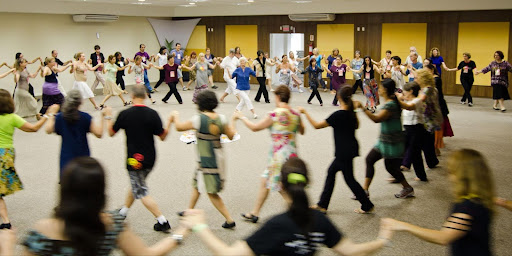
Did you know the word “carol” didn’t always mean “song”? In old French, carole was a type of circle dance accompanied by singing. Early “carols” were both songs and dances! Over many years, the dancing aspect of carols faded, and the Christmas carol remained.
During the Middle Ages, carols spread across Europe. As music evolved during the Renaissance, composers began writing more complex carols for church choirs. In the 1600’s, during the Puritan period in England, Christmas celebrations (and carols!) were banned because they were thought to be too merry. Thankfully, people kept singing them in secret at home, keeping the tradition alive until it could flourish again!
The Victorian Revival: Carols Come Back Strong
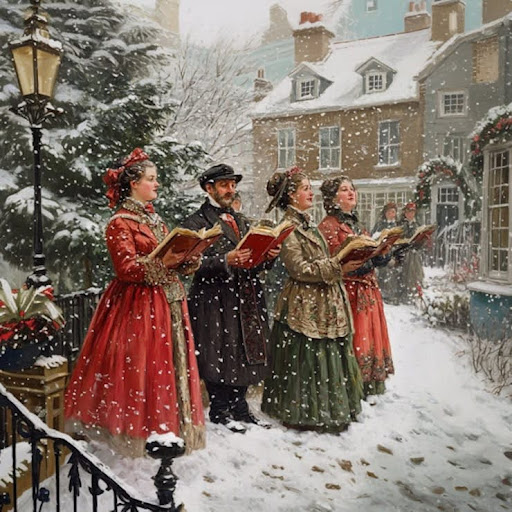
The Victorian Era of the 1800’s brought a big Christmas comeback! Families began celebrating Christmas with decorated trees, gift-giving, and of course, music.
Around this time, the tradition of caroling door-to-door began. Groups of singers, often called “waits,” would go from house to house performing songs in exchange for food, drink, or small gifts. It was cheerful, social, and a great way to spread the Christmas spirit, just like modern caroling today!
The 20th Century: From Choirs to Pop Stars
By the 1900’s, carols had become a worldwide tradition. Some of the most beloved songs we know today were written during this period. Radio, movies, and television introduced new songs that became instant hits, like “White Christmas,” “Rudolph the Red-Nosed Reindeer,” and “Frosty the Snowman.”
Now, Christmas music comes in every style, from jazz and pop to rock and hip-hop! But no matter the beat, the message stays the same: joy, peace, and togetherness.
Why We Still Love Carols Today
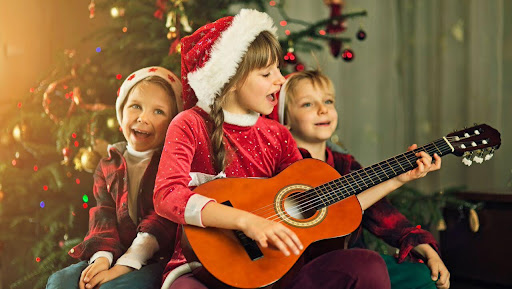
From ancient winter celebrations to modern pop hits, Christmas carols have traveled through centuries and across continents. Christmas carols mean so much to us because they bring people together! Learning Christmas carols is also a great way to discover melody, rhythm, harmony, and more. They can also encourage performance skills and teamwork when sung in choirs or small groups.
When you sing your favorite carols this holiday season, remember that you’re part of a musical tradition more than a thousand years old. Maybe you’ll even write the next famous Christmas song!
If you’re interested in learning to carol or sing, reach out to an Ensemble Music School near you and start your musical journey today!
Author: Marisa E. Cardin
Marisa E. Cardin is the Assistant Manager of Neighborhood Music in Aurora, Colorado. She graduated with a Bachelor of Arts in Creative Writing from Metropolitan State University of Denver, Colorado in 2019. She is published in various magazines and chapbooks, including The Flagler Review and Perfume River Poetry. Most recently, she completed and published her sci-fi trilogy, Jax Cassaway and The Shadow Runners, in 2025. When she isn’t writing, she can be found jamming on her alto saxophone or cuddling her four cats. She currently lives in Aurora, Colorado.